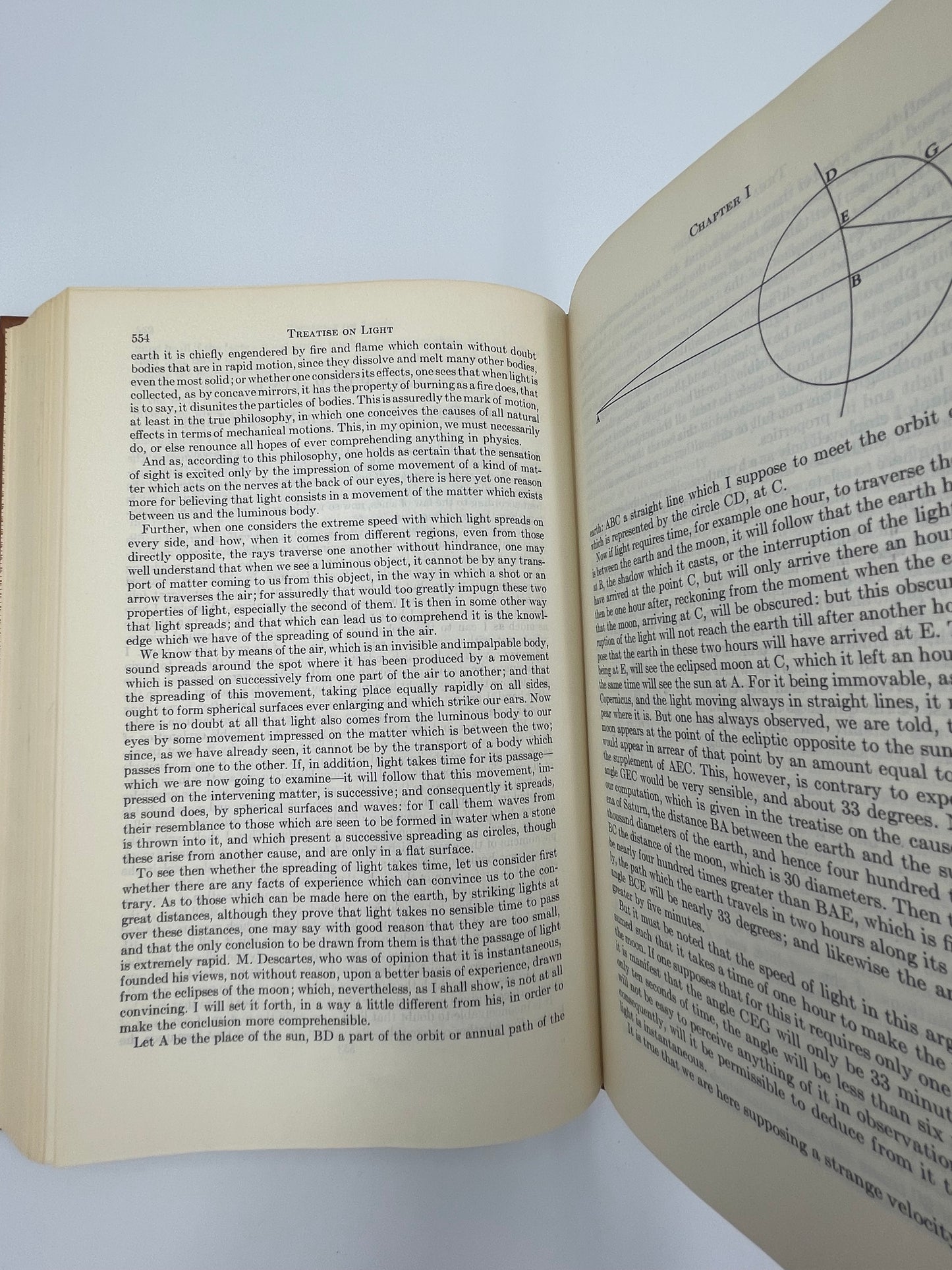
Author: Isaac Newton, Christiaan Huygens
Title: Mathematical Principles of Natural Philosophy (Newton). Optics (Newton). Treatise on Light (Huygens). (Britannica: Great Books of the Western World)
Publisher: Encyclopaedia Britannica
Year: 1952
Format: Hardcover
Condition: Good
Weight: 850 g
Dimensions: 17 x 24 x 3 cm
Full brown leatherette (1952), gilt spine, Smyth-sewn. Part of the Great Books of the Western World series by Encyclopaedia Britannica, edited with guidance from the University of Chicago.
These works are seminal in the history of physics and optics. Together, they represent key developments in the study of physics and optics, with Newton's contributions solidifying the foundations of classical mechanics and Huygens advancing the wave theory of light.
Mathematical Principles of Natural Philosophy (Philosophiæ Naturalis Principia Mathematica) by Isaac Newton (1687) - Often referred to simply as the Principia, this work lays the foundation for classical mechanics. Newton formulates the laws of motion and universal gravitation, offering a unified description of celestial and terrestrial phenomena. The Principia is crucial for its development of the mathematical framework that underpins classical physics and its profound influence on the scientific revolution.
Optics by Isaac Newton (1704) - In this work, Newton explores the nature of light and color, presenting his theory of color based on the observation that a prism can decompose white light into a spectrum of colors. He also discusses the particle theory of light and the phenomenon of dispersion. Optics is important for its contributions to the understanding of light and color and for laying the groundwork for the later development of optical science.